Showing posts with label Angelus Address. Show all posts

Sunday, March 24, 2013

Palm Sunday, World Youth Day, and Mary

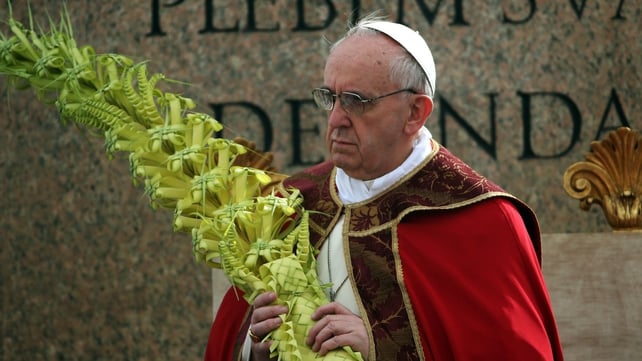
Today, as per the custom for Palm Sunday in Rome, the youth of Rome gathered to hear Pope Francis.  In both his homily and Angelus address the Pope spoke of Mary.  

Homily
Let us ask the intercession of the Virgin Mary. She teaches us the joy of meeting Christ, the love with which we must look to the foot of the Cross, the enthusiasm of the young heart with which we must follow him during this Holy Week and throughout our lives. May it be so.”

Many saints of the tradition have regarded Mary as a teacher.  In fact our most recent popes referred to a specific "school of Mary."  Mary teaches us about her son and she is a guide for us as we strive to live more faithful lives.  By her example she teaches.  Today Pope Francis tells us that Mary specifically teaches us the joy of meeting Christ.  

Angelus

Dear Brothers and Sisters, At the end of this celebration, we invoke the intercession of the Virgin Mary, that she may accompany us during Holy Week. May she, who followed her Son with faith all the way to Calvary, help us to walk behind him, carrying his Cross with serenity and love, so as to attain the joy of Easter. May Our Lady of Sorrows support especially those who are experiencing difficult situations. My thoughts turn to the people afflicted with tuberculosis, as today is the World Day against this disease. To Mary I entrust especially you, dear young people, and your path towards Rio de Janeiro: This July, Rio! Prepare your hearts spiritually. May all of you have a good journey!

Given the nature of today's liturgical celebration, Pope Francis rightly focuses on the sorrows Mary endured on the way to Calvary.  Catholics throughout the holy season of Lent have gathered at their local churches or on their own to pray the stations of the cross.  Many people who pray the stations often sing verses of the Stabat Mater after each station.  The Stabat Mater has been used as the Sequence for the feast of Our Lady of Sorrows.  While the verses do not relate to each station, it incorporates an element of Marian piety within the Stations of the Cross, thereby allowing an individual to make the Way of the Cross with Christ and journey with His mother to Calvary.  

In the Angelus, Pope Francis invoked Mary's intercession to accompany us, that is the Church, throughout Holy Week.  He cites the example of Mary who journey with Christ along the way of the Cross.  As Mary walked with Christ, by her example then we too should carry our crosses with him.  He then invoked the intercession of Our Lady of Sorrows for those who suffer.  In so doing he implicitly invited them to unite their sufferings to Christ and to share their burden with Mary.  Finally he entrusted the young people to Mary's intercession as they prepare for World Youth Day in Rio de Janeiro. 

Notice the way in which Pope Francis called upon Mary.  He first invoked her intercession that she may accompany.  Then he called upon her support for those suffering.  And then he entrusted to her intercession other people.  Invoke, accompany, support, and entrust.  In reading many of Pope Francis' other writings these are constant themes that he addressed in terms of Mary and in general the call to discipleship.  Expect to see this become a theme of his Mariological thought throughout his papacy.  

Sunday, March 17, 2013

Pope Francis's First Angelus Address

Today Pope Francis delivered the first Angelus address of his pontificate.  Given that he spoke before and after a Marian prayer, the Angelus, one should not be surprised that Our Lady was invoked in some way.  He shared three pertinent things regarding Mary. 

1.  Pope Francis relayed the story of an event on the occasion of welcoming Our Lady of Fatima into Argentina (I presume this is a pilgrim statue that arrived for the first time in the country.)  Pope Francis recounted "Our Lady of Fatima had just arrived in Buenos Aires and there was a big Mass for the sick. I went to hear confessions at that Mass.And near the end of the Mass I got up, because I had to administer holy oil. ..."  Pope Francis by no means intended to covey a theological point about Our Lady of Fatima.  But what is important in this situation is to notice what happened.  Our Lady of Fatima arrived in Buenos Aires, and there was a Mass for the sick.  Additionally, the Archbishop went to hear confessions.  As he set up the scene to convey a story about mercy, Pope Francis found it necessary to reference the specific occasion, a celebration in honor of Our Lady of Fatima.  

The Church has a great devotion to Mary; on certain occasions festivals are held in her honor.  But the focus was not on Our Lady, but it was on the sacraments--Holy Eucharist, Confession, and Anointing   Our Lady brought together large numbers in order to present them to her Son.  Our Lady's apparition in Fatima in 1917 was the catalyst of conversions throughout the world and a return to the sacramental life of the Church.  While it was just a simple, scant reference to Fatima, there is much more that can be drawn from it as the Holy Father addressed the theme of mercy.  As seen by his story, Mary brought people together to experience the mercy of God in the sacraments. 

2.  Before praying the Angelus, Pope Francis stated: "We invoke the intercession of Our Lady who held in her arms the Mercy of God made man."  People can relate to this image of Mary.  Mother's can relate to Mary who held Jesus in her arms.  This image is evocative of many scenes in Christ's life, of course it evokes Mary holding the Christ child, but in this season of Lent, it also evokes the image of Mary holding the lifeless body of her son  in her arms.  Jesus, giving his life for the salvation of the world, was the supreme act of mercy par excellence.  By saying yes to the angel, Mary cooperated in God's plan for the redemption of the world through the mercy of the Father, Son, and Spirit.  Lastly, Pope Francis spoke of the incarnation, God made man, which looks to Mary as the Mother of God, a title that we so often pray in the Hail Mary.  In the Hail Holy Queen we even call Mary the "Mother of Mercy," that is, Mother of the one who is Mercy Himself.  


3.  In concluding his address, Pope Francis stated: "But Jesus has called us to be part of a new family: his Church, this family of God, walking together along the way of the Gospel. May the Lord bless you, may Our Lady protect you. Do not forget this: the Lord never wearies of forgiving! We are the ones who weary of asking for forgiveness."  

There are two important things to note from this reference.  The first is the fact Pope Francis invoked the protectress role of Mary.  He prayed for Mary's protection over Pope Benedict and over Rome, and made a special pilgrimage to Shrine of Our Lady Protectress of Rome at the Basilica of Santa Maria Maggiore.  This theme I believe will remain consistent over his papacy as seen by other writings as archbishop of Buenos Aires.  Secondly, He spoke of Jesus calling us to be part of a new family, his Church, which is the family of God.  At first glance it may not seem to be overtly Marian, but it is!  The constitutive elements of a family are a father, mother, and children.  If we view the Church as a family, then God is our Father, and the Church is mother.  But what can be said of the Church can be said of Mary.  So Mary also is our mother.  She is the mother of God's children.  She is in fact Mother of the Church.  In this Christian family then, it is necessary for there to be a mother, and that mother is both Mary and the Church.